End-to-End Sustainable Development
Almost everything we do involves water, one of the world’s most crucial resources. That’s why sustainability is a natural part of everything we do, every day. We consider the whole picture, taking into account social, economic, and environmental aspects throughout the entire journey – from the idea stage to when our products are used in our customers’ daily lives.
Our Focus Areas
Sustainability is one of FM Mattsson Group’s strategic cornerstones and an integral part of how we develop our business over time. For us, it means developing products that are made to last, using resources responsibly in our processes, and taking responsibility for people in our own operations and across the value chain.
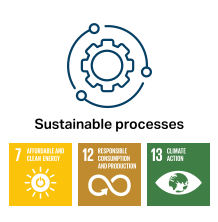
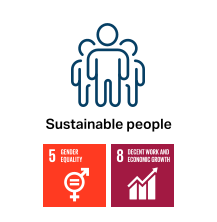
Our sustainability work is built around three overarching focus areas: sustainable products, sustainable processes and sustainable people. Together, they provide a common framework that connects product development, sourcing, production, employees, business ethics and responsibility across the value chain.
The UN Sustainable Development Goals provide an important global context for sustainable development. Based on our business and our most significant sustainability topics, we see particularly strong links to Goal 6 Clean Water and Sanitation, Goal 7 Affordable and Clean Energy, Goal 5 Gender Equality, Goal 8 Decent Work and Economic Growth, Goal 12 Responsible Consumption and Production, and Goal 13 Climate Action.
The Sustainable Development Goals help guide our work. At the same time, our priorities are shaped by where we as a Group have the greatest impacts, risks and opportunities. We are not at the finish line, but we have a clear direction and are working step by step to translate our priorities into targets, responsibilities, actions and follow-up.
From raw materials to long-term use
Our value chain begins long before a product reaches the customer. It includes raw materials such as copper and zinc used to make brass, components and finished goods sourced from suppliers, product development, purchasing, production in Mora, transport, sales, customer support, product use, service and recycling.
This means our responsibility extends beyond our own operations. Some issues are directly within our control. Others we can influence through the requirements we set, the choices we make and the information we provide.
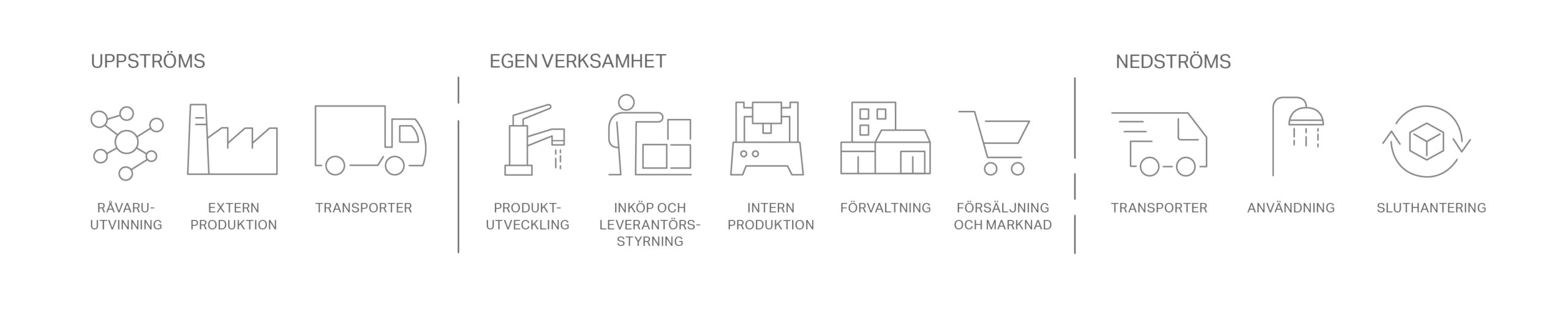
- The upstream value chain includes raw materials, components, finished goods, outsourced production and transport. Here, we work with supplier requirements, risk assessments, dialogue, follow-up and better data.
- Our own operations include product development, purchasing, production, assembly, warehousing, sales and customer support. Here, we can directly influence areas such as material choices, energy, water, chemicals, waste, health and safety, and product information.
- When our products are in use, sustainability relates to functionality, water and energy performance, service, spare parts, repair and how materials can be recovered when a product is replaced.
How we put sustainability into practice
Our sustainability work focuses on the areas where our business has the greatest impacts, risks and opportunities. These include climate, water, materials and circular economy, chemicals and hazardous substances, people in our own operations and value chain, and responsible business conduct.
Focus on water and energy
Water is central to both our business and our products. In our own operations, we monitor water use, particularly where water is used in production and industrial processes.
The use phase represents an important opportunity. We therefore develop products and solutions that can help enable more efficient use of water and energy, for example through flow control, cold-start technology, touchless solutions, smart controls and clear product information.
Reducing our climate impact over time
Our climate impact arises across several parts of the value chain, including materials, energy, transport, company cars, suppliers and the use of our products.
We are working on energy efficiency, transport monitoring, increasing the share of electric vehicles, improving product data, engaging suppliers and continuing to develop products that can help reduce water and energy use. Our next step is to develop new climate targets and a climate transition plan based on a more complete greenhouse gas emissions baseline.
Materials and circular economy
Our products depend on materials that need to be used wisely. Metals such as brass have a high recycling value, while society also needs to reduce its dependence on virgin resources.
We work to develop products with long lifetimes, high quality, good repairability and access to spare parts. In production, we also work to reduce material losses, improve waste management and expand opportunities to recycle and reuse materials.
Managing chemicals and hazardous substances
Our products and processes involve materials, chemicals and surface treatment. Effective controls, regulatory compliance and substitution where possible are therefore important parts of our work.
We comply with legal requirements and permits, carry out internal controls and risk assessments, and monitor the development of new requirements for materials and substances used in our products and processes.
Responsibility in the supply chain
We depend on suppliers and business partners across several parts of our value chain. We therefore work with clear requirements, risk-based follow-up and ongoing dialogue.
Our Business Partner Code of Conduct sets out expectations relating to areas including human rights, working conditions, health and safety, environmental responsibility, business ethics and anti-corruption.
A safe and inclusive workplace
Engaged employees who feel safe at work are essential to our long-term development. We focus on health and safety, leadership, inclusion, skills development and employee dialogue.
This means both preventing accidents and ill health, and creating workplaces where people feel involved, take responsibility and have the opportunity to contribute to our development.
Responsible business conduct
Responsible business conduct is about how we make decisions, conduct business and build trust. At FM Mattsson Group, this includes business ethics, anti-corruption, conflicts of interest, fair competition, whistleblowing, internal controls and business partner screening.
We have zero tolerance for corruption and bribery and use policies, training, reporting channels and risk-based follow-up to strengthen a responsible business culture.
2025 at a glance
2025 was an important year for FM Mattsson Group’s sustainability work. We published our first integrated sustainability reporting in accordance with CSRD and ESRS, strengthened governance, policies and reporting processes, and gained a clearer understanding of our most significant sustainability topics in our own operations and across the value chain.
This work has given us a stronger foundation for developing targets, actions and follow-up. Our focus is now shifting from reporting to implementation, with clearer responsibilities, better data and more regular follow-up across the business.
- Selected 2025 key figures
- Scope 1, 2 and 3 emissions baseline completed
- Total emissions decreased by 14%
- Scope 1 and 2 emissions decreased by 18%
- 99% of emissions are in Scope 3
- 50.7% reused or recycled materials in our products
- 67,609 m³ of water reused or recirculated
- Our climate work enters its next phase
- 95.2% attendance rate
- 71% of high-risk suppliers audited on site
- 89% completed Code of Conduct training
Läs mer
Scope 1, 2 and 3 emissions baseline completed
Following the reporting year, we completed our 2024 greenhouse gas emissions baseline and compiled our 2025 emissions results for Scope 1, 2 and 3. This gives us a more complete picture of the Group’s climate impact and a stronger basis for developing future climate targets, actions and follow-up.
Total emissions decreased by 14%
The Group’s total greenhouse gas emissions decreased from 115,940 tCO₂e in 2024 to 99,538 tCO₂e in 2025, based on the updated emissions baseline.
Scope 1 and 2 emissions decreased by 18%
Emissions from our own operations and purchased energy, Scope 1 and market-based Scope 2, decreased from 1,415 tCO₂e in 2024 to 1,159 tCO₂e in 2025. The reduction was mainly driven by lower emissions from company cars and purchased energy.
99% of emissions are in Scope 3
The vast majority of our climate impact occurs across the value chain. Supplier engagement, product development, material choices, product data, transport and circular principles are therefore important parts of our continued climate work.
50.7% reused or recycled materials in our products
In 2025, 50.7% of product-related material inflows came from reused or recycled materials. This includes raw materials, components and packaging materials.
67,609 m³ of water reused or recirculated
Across our own operations, 67,609 m³ of water was reused or recirculated. Water management is particularly important in Mora, where most of the Group’s water use takes place.
Our climate work enters its next phase
Emissions intensity decreased by 1% in 2025. The target of a 5% reduction was not achieved. Scope 1 and Scope 2 emissions decreased, while emissions from upstream transport increased. We are now developing new climate targets and a climate transition plan based on a more complete greenhouse gas emissions baseline.
95.2% attendance rate
The attendance rate in 2025 was 95.2%. Our target is 96%, and our work on health, safety, engagement and well-being continues.
71% of high-risk suppliers audited on site
In 2025, on-site audits were carried out at 20 of the 28 suppliers classified as high risk. The 100% target was not achieved, and follow-up and improvement actions are continuing.
89% completed Code of Conduct training
89% of employees completed Code of Conduct training. Among employees in higher-risk functions, 94% completed advanced training in responsible business conduct and anti-corruption.
Commitments and external assessments
We use external initiatives, frameworks and assessments to support transparency, learning and continuous improvement.
UN Global Compact
FM Mattsson Group joined the UN Global Compact in 2025 and supports its Ten Principles in the areas of human rights, labour, environment and anti-corruption.
EcoVadis
In 2026, FM Mattsson Group was awarded an EcoVadis Silver Medal, placing us among the top 15% of companies assessed by EcoVadis globally over the past 12 months.
Link to EcoVadis Recognition Page
Nasdaq ESG Transparency Partner
FM Mattsson AB was certified as a Nasdaq ESG Transparency Partner in 2023. The certification is awarded to companies that demonstrate a high level of market transparency on environmental, social and governance matters.
Kranmärkt
Our workplaces, meetings and external conferences and training events are free from bottled water.
Read more in our Annual Report
For more information about our sustainability topics, targets, actions and performance, see our Annual Report.
Link to Annual Report Årsredovisning 2025 (in Swedish)